
Syros & Hermoupolis
Hermoupolis, capital of the Cyclades, was in the nineteenth century one of the foremost commercial, maritime and intellectual centres of modern Greece — a city born of the sea that became a symbol of culture.
A city born of the Revolution
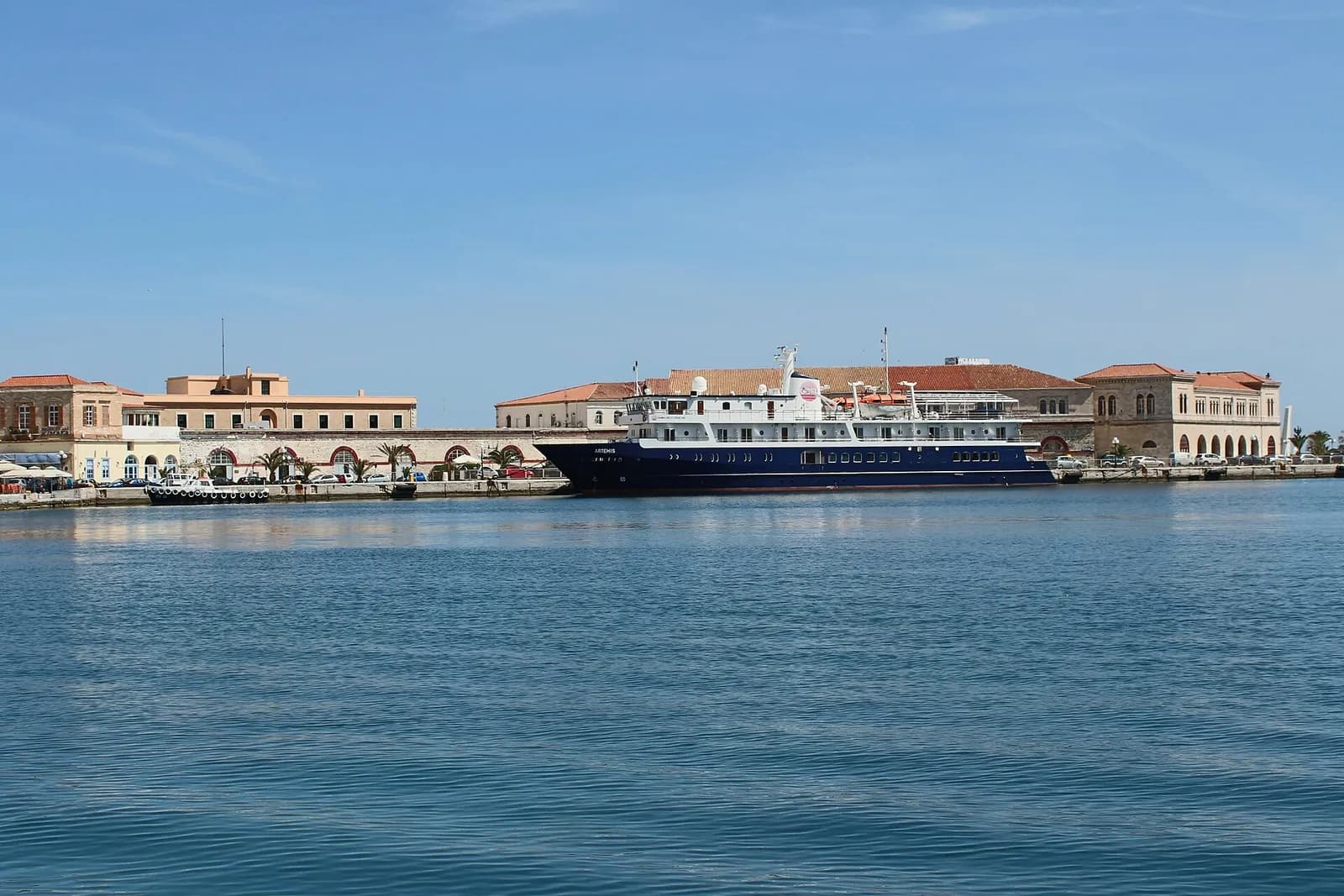
From 1822 the then deserted shore of Syros received thousands of refugees of the Greek Revolution from Chios, Psara, Kasos, Smyrna, Kydonies and elsewhere. With daring, commercial flair and seafaring skill they built an entire city within a few years.
In 1823 they built the Church of the Transfiguration, today the Orthodox cathedral of Syros. In 1826, at an assembly of the first settlers outside the church, the town was named Hermoupolis in honour of Hermes, god of commerce, on the proposal of the Chian Loukas Rallis. By 1828 the census already counted 13,805 inhabitants.
The golden age
Between 1840 and 1880 Hermoupolis grew rapidly into a cosmopolitan city with a strong merchant class. In 1844 the newly founded National Bank of Greece opened its first branch here, and in 1856 Hermoupolis is recorded as the second most populous city in the country after Athens.
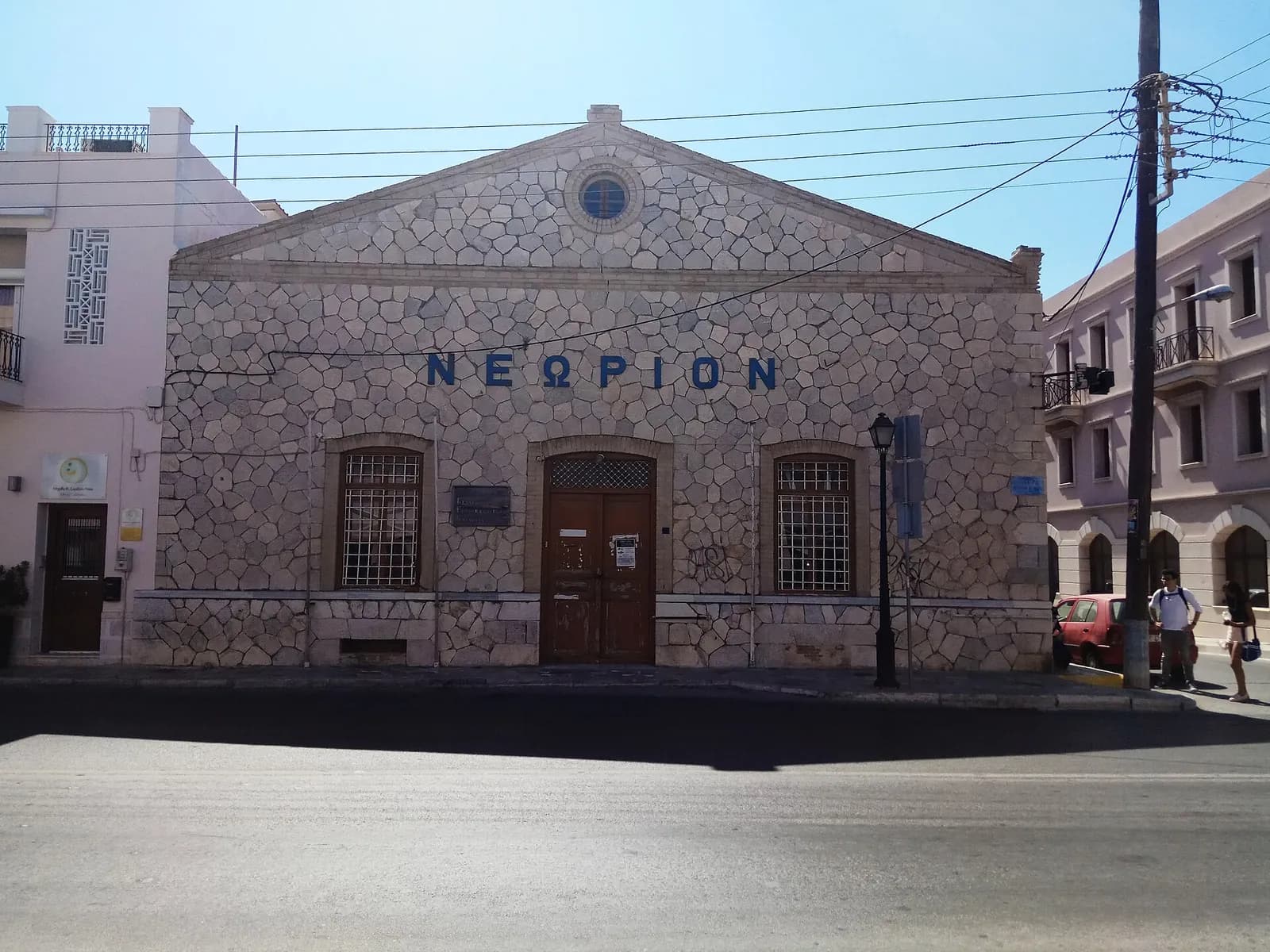
A large industrial zone grew along its shore, with a shipyard, tanneries, spinning mills and steam mills. The Neorion was founded in April 1861 by the first Greek Steamship Company under the supervision of the Italian architect Pietro Sampo, and remains one of the oldest and largest shipyards in Greece. The city’s industrial heritage comes alive in the Industrial Museum of Hermoupolis.
Ano Syros
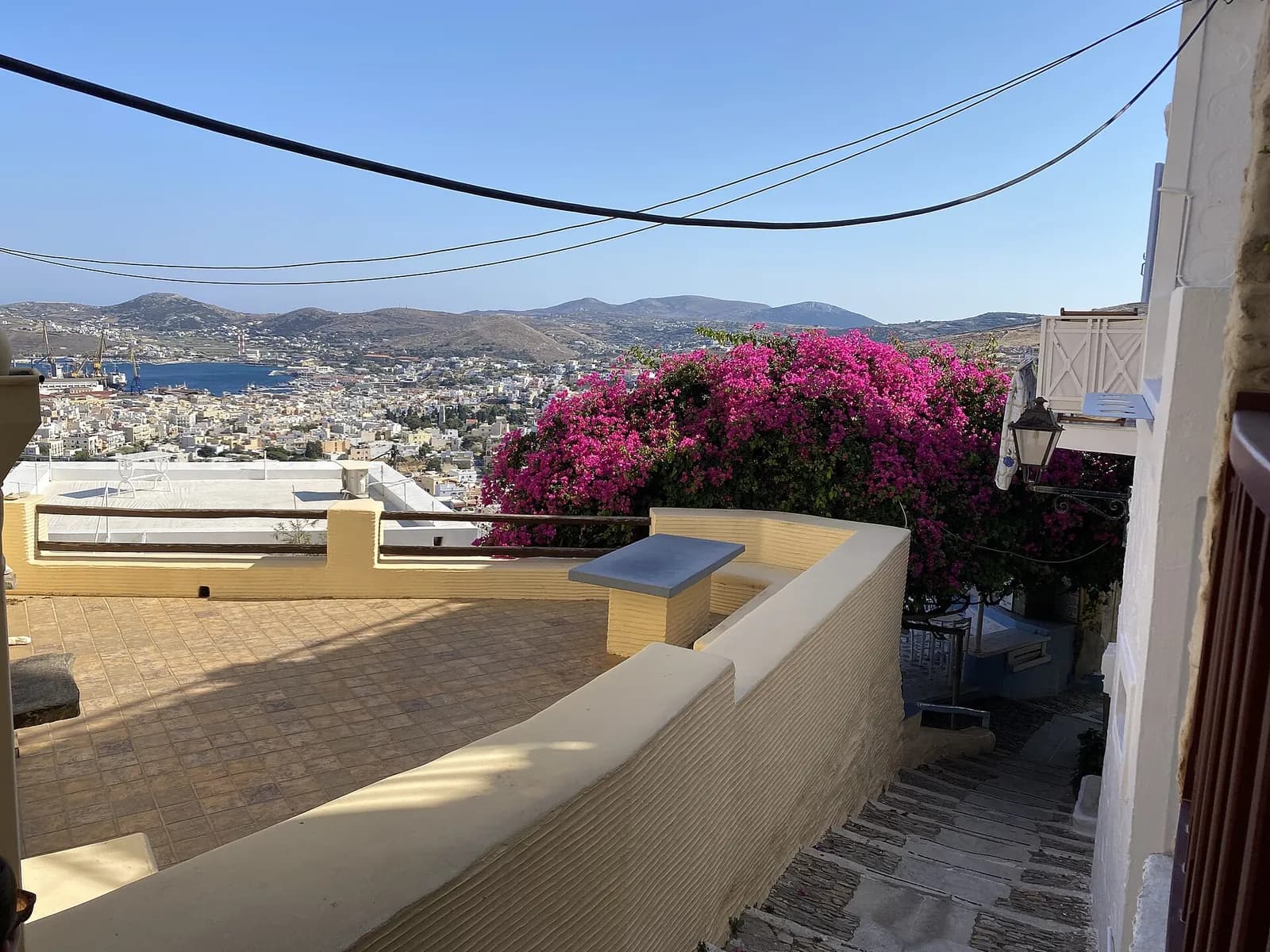
Above Hermoupolis rises Ano Syros, the medieval settlement built as a fortified town against piracy. Its Catholic inhabitants descend from Venetian merchants and Franks of the Latin era, when the island belonged to the Duchy of Naxos, and for centuries Syros stood under the protection of France.
Listed as a traditional settlement since 1988, Ano Syros is the home of Markos Vamvakaris and his “Frangosyriani”. The harmonious coexistence of Orthodox and Catholics remains one of the island’s finest traits.
Miaoulis Square
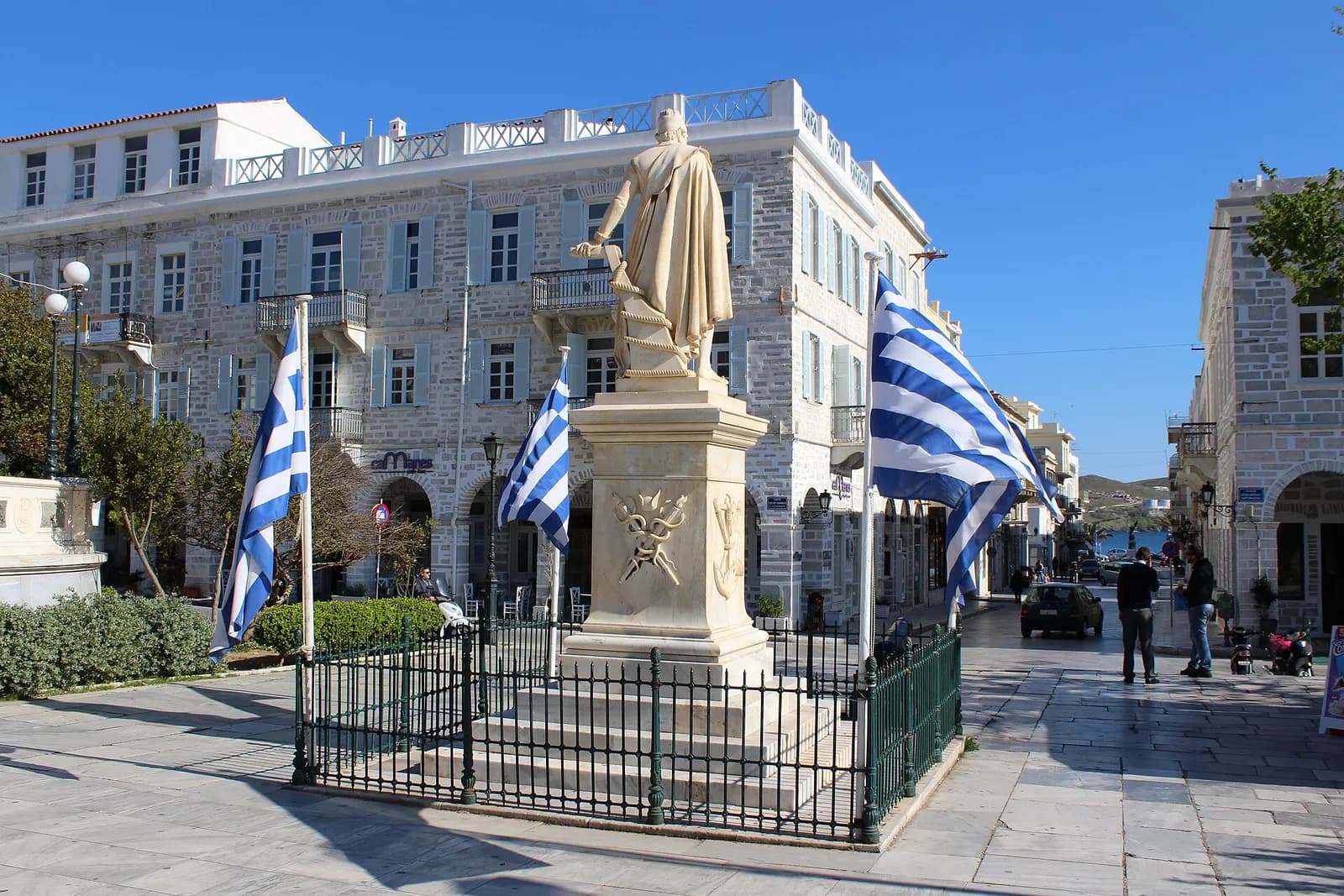
The largest and most historic square of Hermoupolis was laid out after 1847 by the Bavarian architect Wilhelm von Weiler and first named “Otto Square”. In 1862 it was renamed “Leotsakos Square”, and in 1868 its central section was paved with marble from Tinos.
It took its present name with the unveiling of the statue of Admiral Andreas Miaoulis in 1889. Framed by the Town Hall, the Historical Archive and the former “Hellas” Club, it remains the heart of city life.
Ziller’s Town Hall
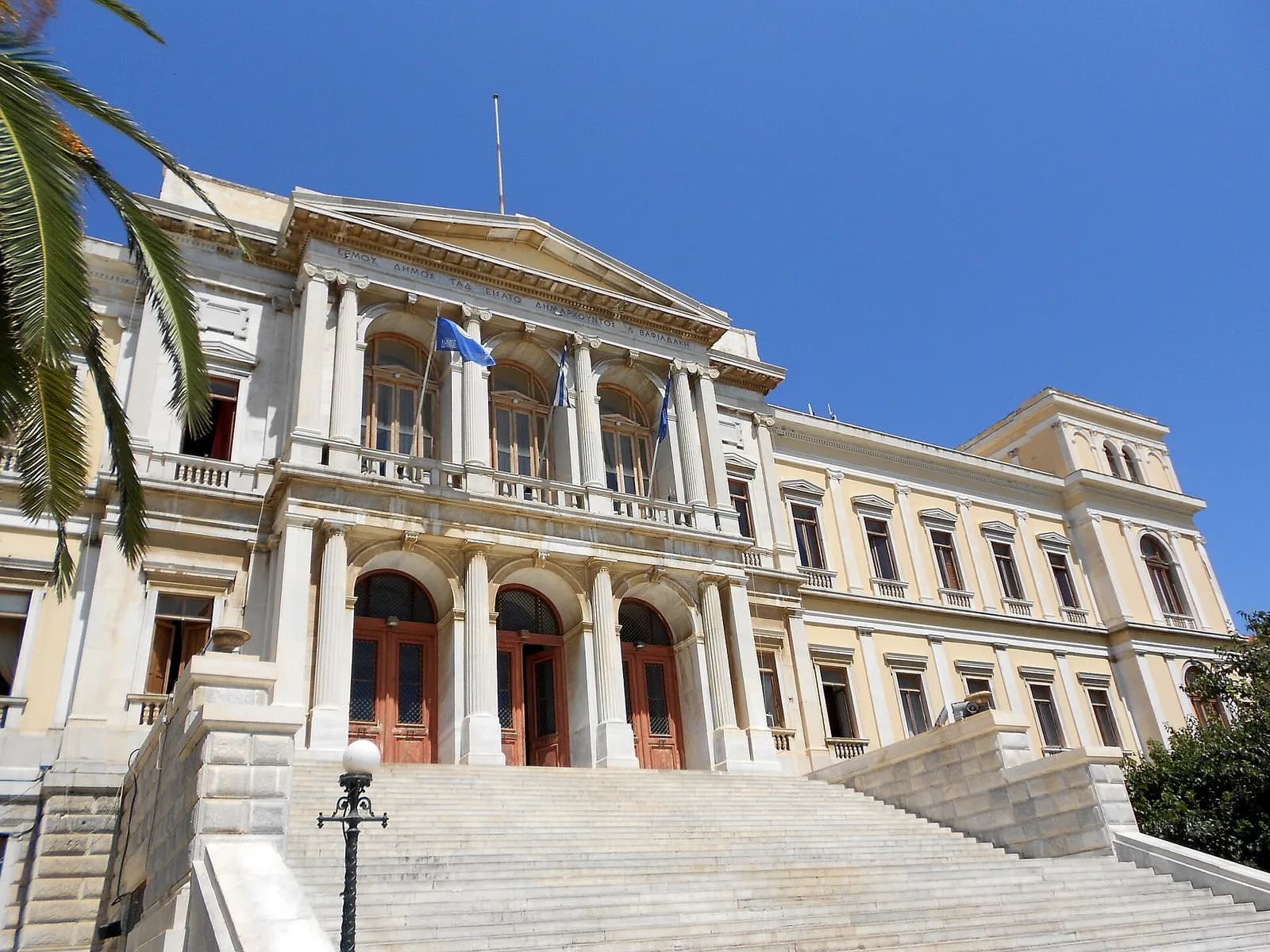
Hermoupolis Town Hall, designed by Ernst Ziller, was built between 1875 and 1891 on the north side of the main square, exactly on the axis of the city’s great commercial street. Its monumental presence recalls a palace more than a municipal building.
During construction the main entrance was moved up to the first floor and the broad marble staircase that now dominates the square was added. It remains one of the most important neoclassical public buildings in Greece.
The Apollo Theatre
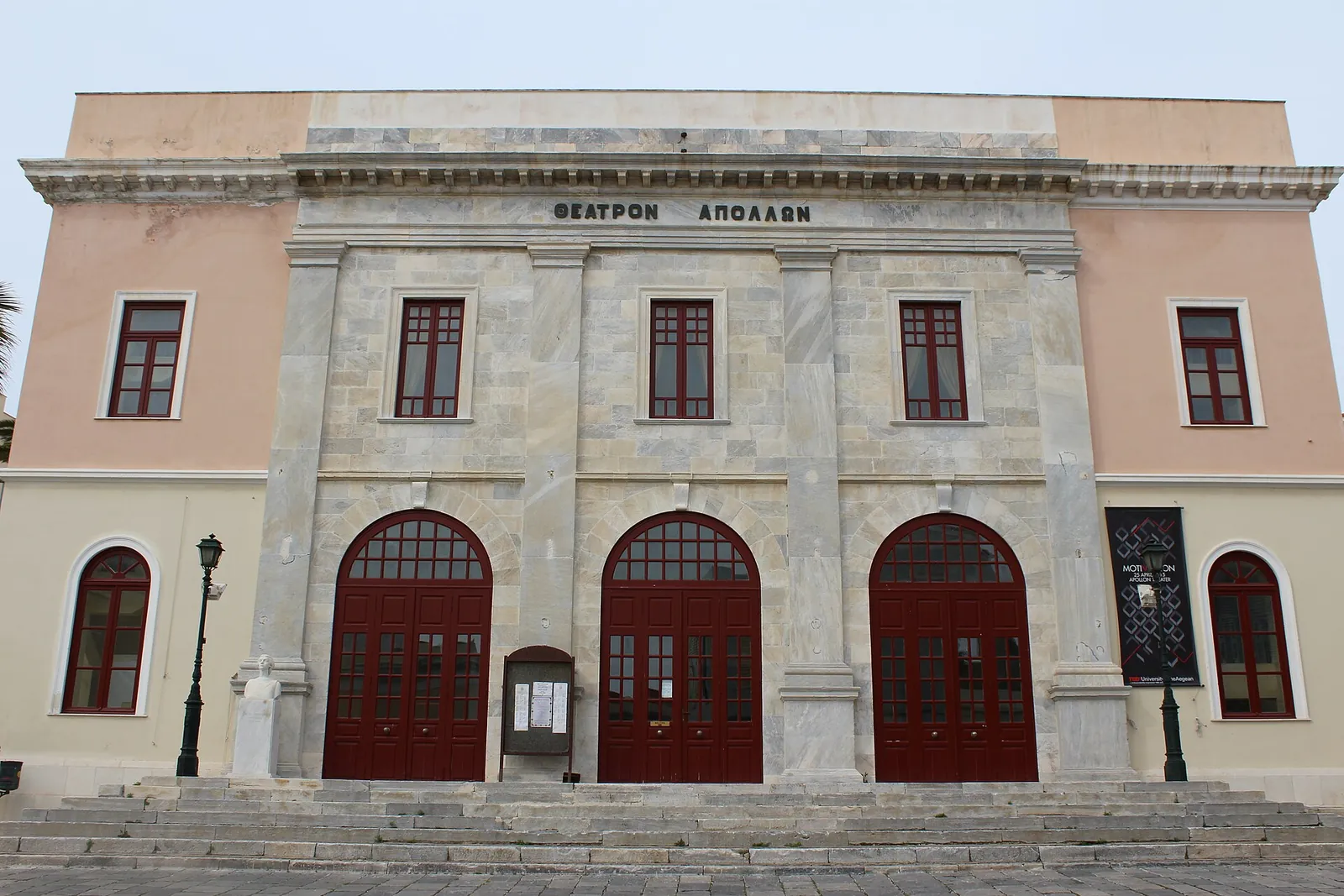
On 30 October 1861 the Municipal Council unanimously decided to build a Theatre and a Club in the city centre. The “Apollo” was founded at the end of 1862 to designs by the Italian architect Pietro Sampo and opened on 20 April 1864 with Verdi’s “Rigoletto”, in the presence of its initiator, Michail Salvagos.
Although often called a “little La Scala”, its design draws on at least four Italian models: La Scala in Milan, the San Carlo in Naples, the theatre of Castelfranco and the Pergola in Florence. Its ceiling is adorned with portraits of poets and composers, from Homer and Dante to Mozart and Verdi.
The greatest names of the modern Greek stage performed here; on 24 March 1953 Marika Kotopouli gave the last performance of her life on its stage. Since its restoration was completed in 2000, the theatre has hosted the Aegean Festival, Animasyros and the International Classical Music Festival of the Cyclades.
Its façade is the centrepiece of our Lodge emblem, a symbol of the Light and of the city’s intellectual tradition.
The “Hellas” Club
As early as the 1830s the merchants of Hermoupolis founded clubs on the model of English gentlemen’s clubs — places for meeting, news, informal exchange and social events. Among them were the “Hermes” Club (1836), the Club of the Chians and the Club of the Hermoupolitans.
The “Hellas” Club building was completed in 1863 at the north-east corner of Miaoulis Square, designed by Pietro Sampo and financed by Michail Salvagos to unite the city’s two clubs, “of the Chians” and “of the non-Chians”. Its monumental façade, with marble balconies and a three-arched portico on Tuscan columns, and its rooms with remarkable murals still preserve the atmosphere of the era.
Today the building houses the Cultural Centre and the Municipal Library of Hermoupolis. In its small garden stand the busts of the men and women of letters of Syros — Dimitrios Vikelas, Emmanuel Roidis, Timoleon Ampelas, Rita Boumi-Papa, Kostis Bastias and Georgios Souris, whose name our Lodge bears.
The Lyceum Club of Greek Women of Syros
The Lyceum Club of Greek Women of Syros was founded in 1915, the first regional branch after the Central Lyceum Club was founded in Athens in 1911. It remains faithful to the aims of its founder, Kallirroi Parren: the protection of women, mothers and children, and the preservation and promotion of Greek traditions and customs.
Great benefactors donated their homes to the Lyceum in recognition of its social and cultural work. In 2015 it celebrated its centenary by hosting the Panhellenic Congress of the Lyceum Clubs in Hermoupolis, and in October 2023 it opened its Historical and Folklore Museum.
Vaporia and St Nicholas
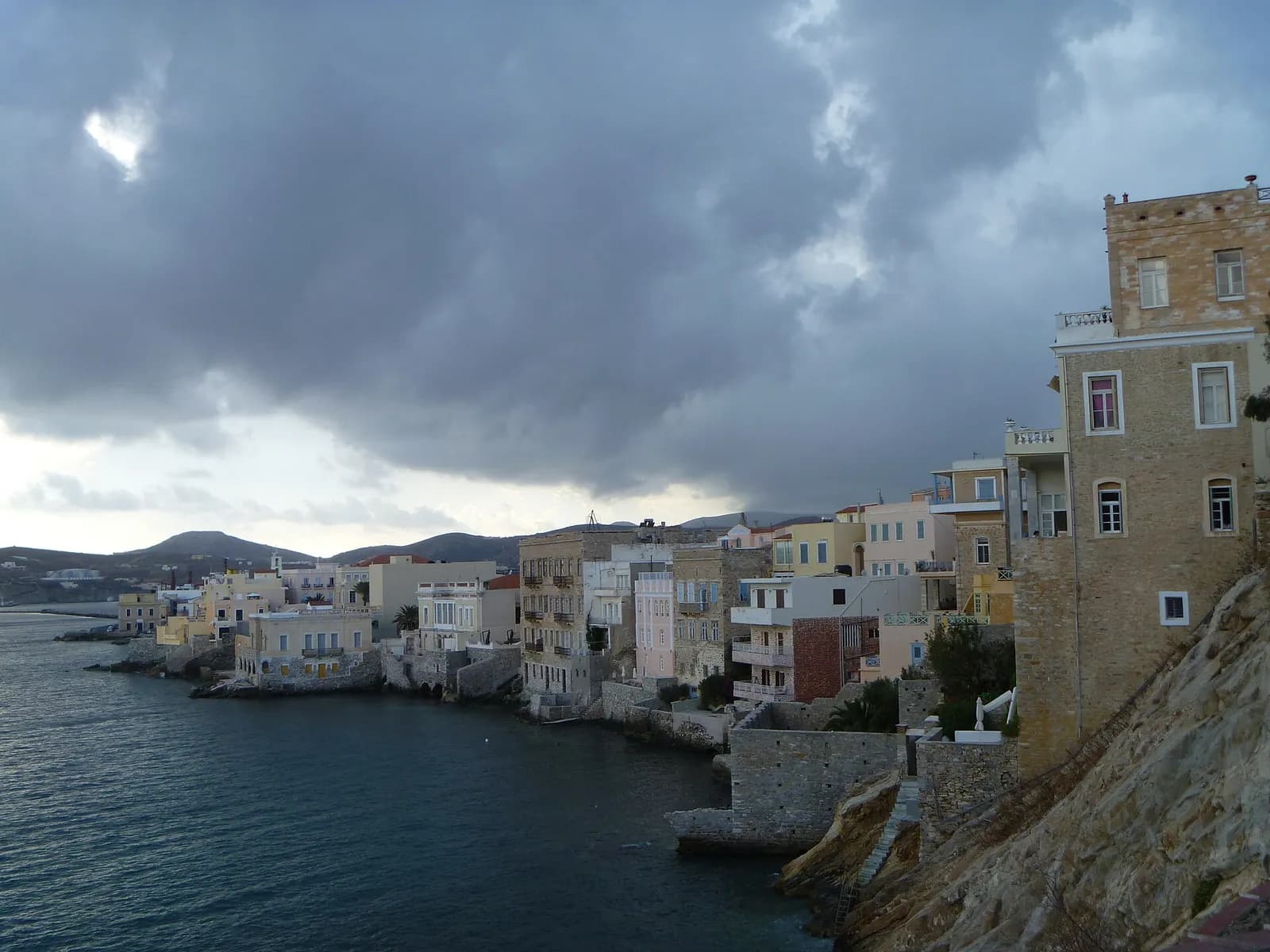
In 1848 work began on Vaporia, the aristocratic quarter of Hermoupolis whose neoclassical mansions rise straight out of the sea, and on the majestic Church of St Nicholas, patron saint of the city.
Georgios Souris, a son of Hermoupolis
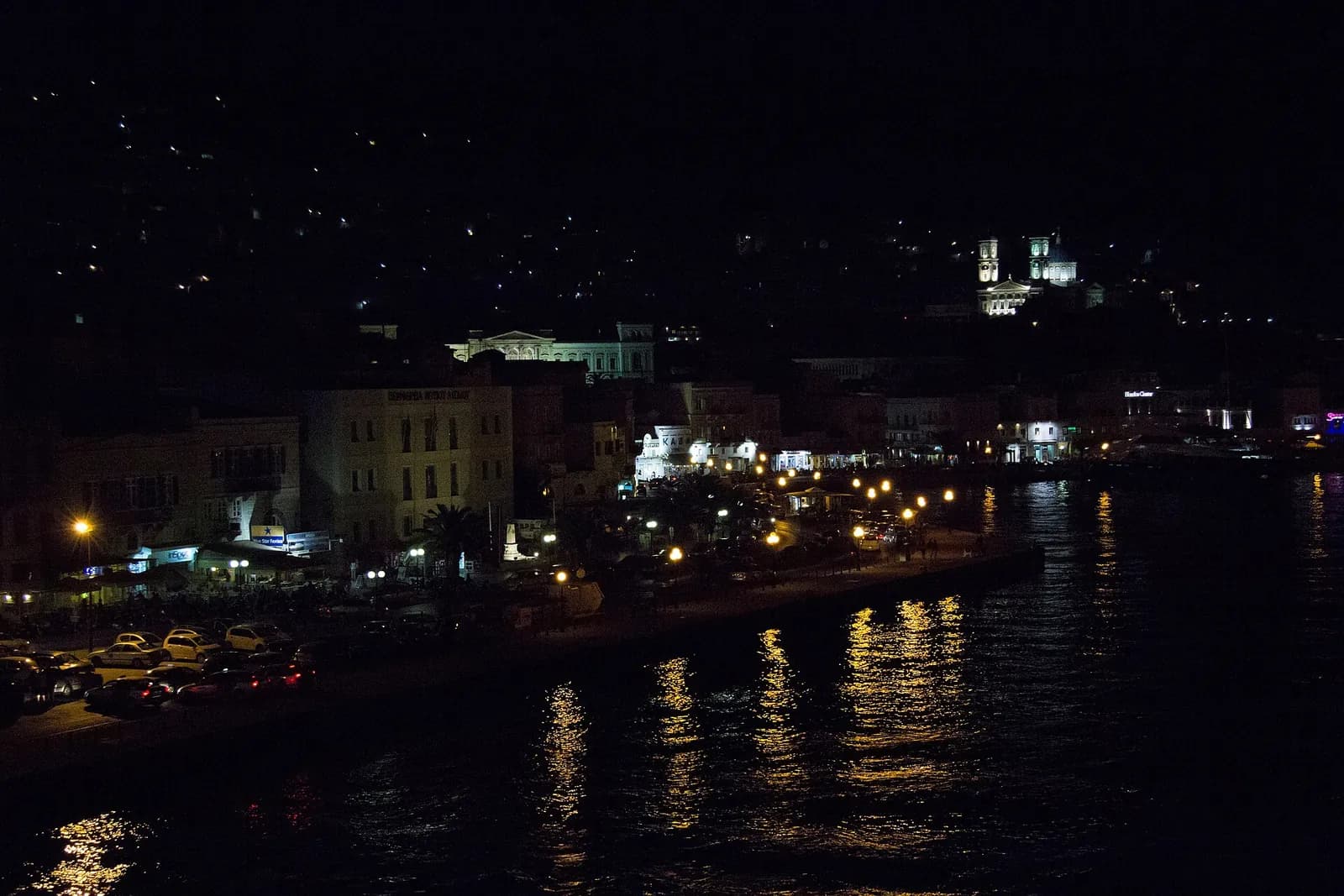
Georgios Souris was born in Hermoupolis on 2 February 1853. Hailed as a “modern Aristophanes”, he published the satirical verse newspaper “O Romios” from 2 April 1883 until 1918 and was nominated five times for the Nobel Prize in Literature.
Our Lodge honours his name and the intellectual tradition of the city that raised him.
Syros through time
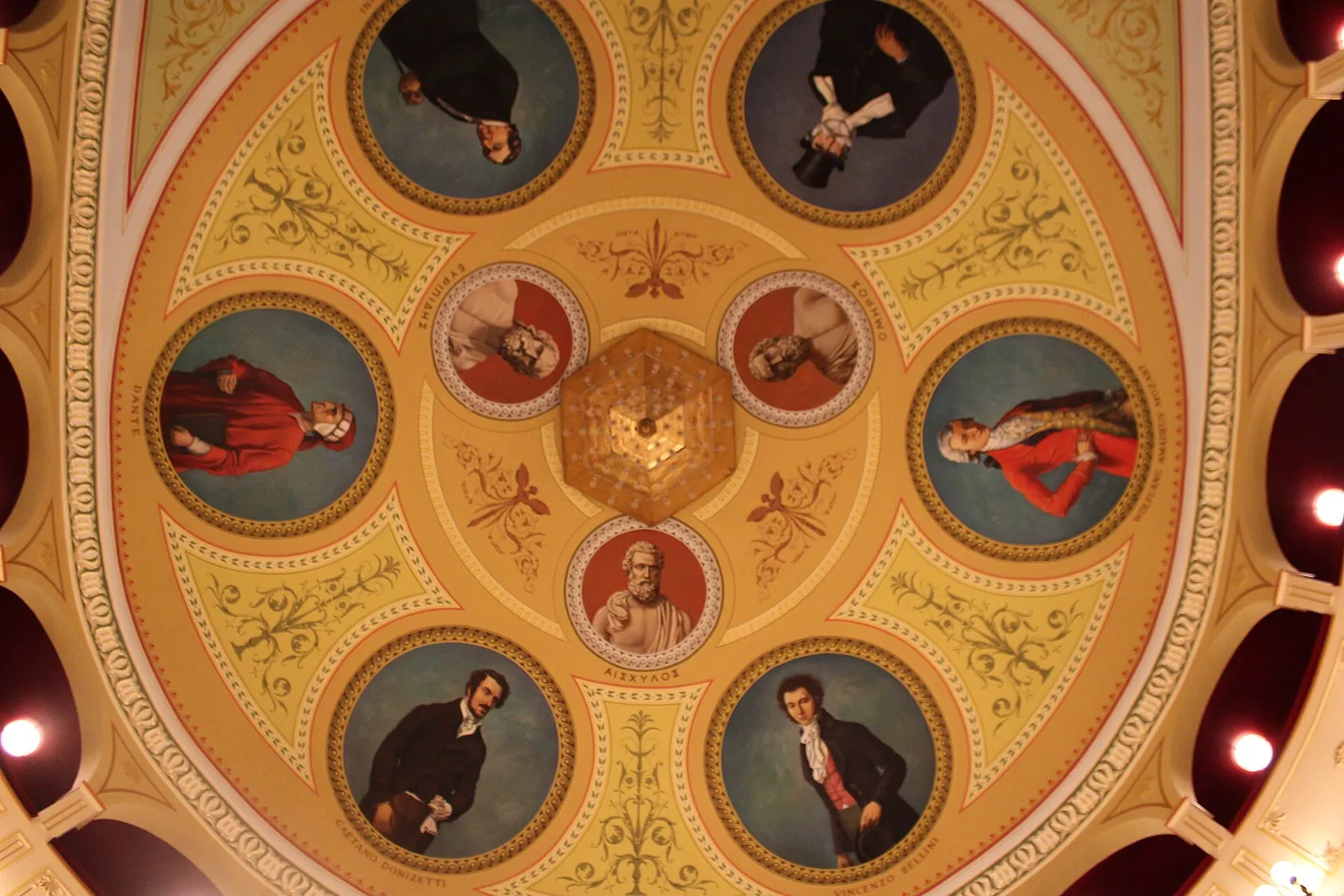
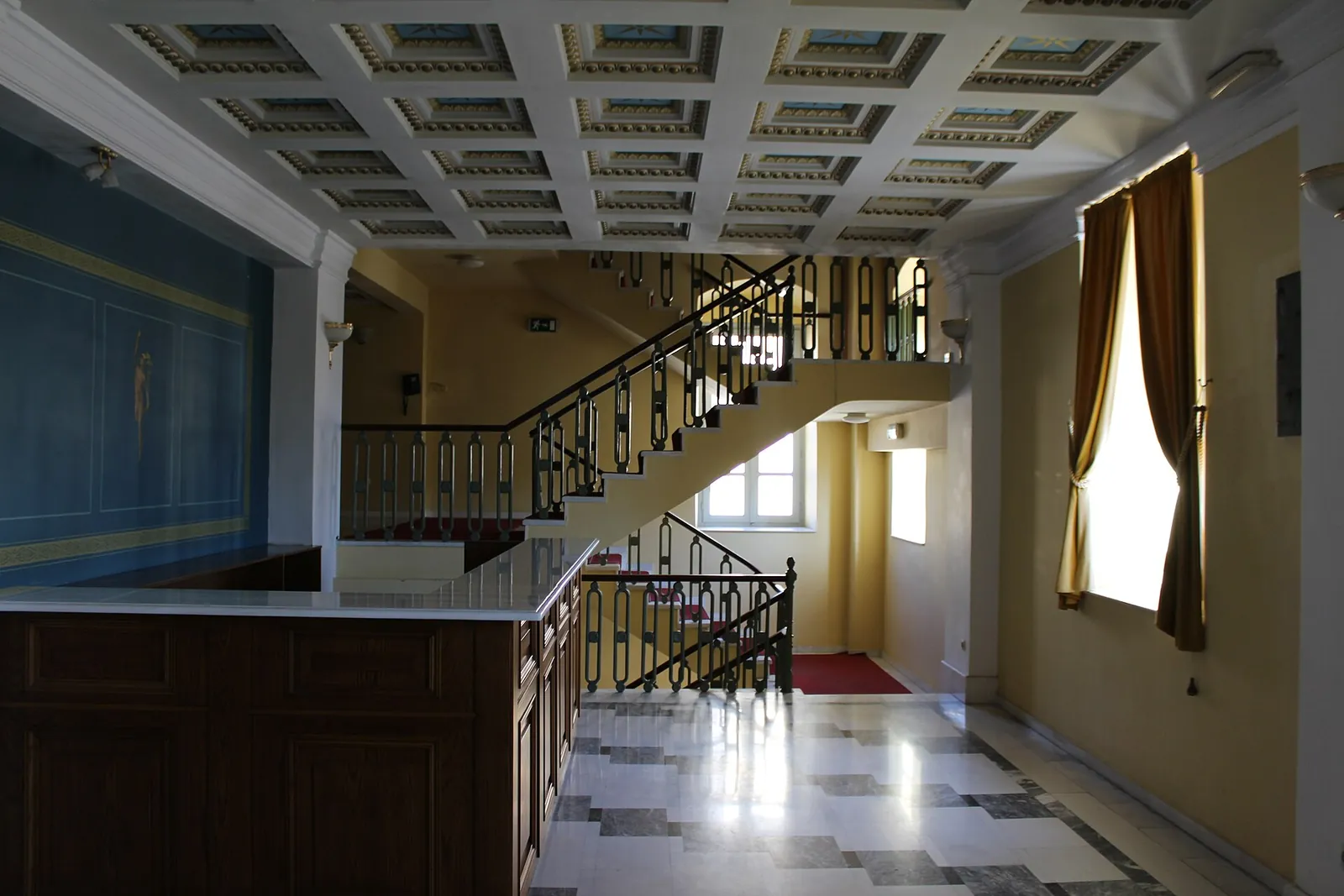
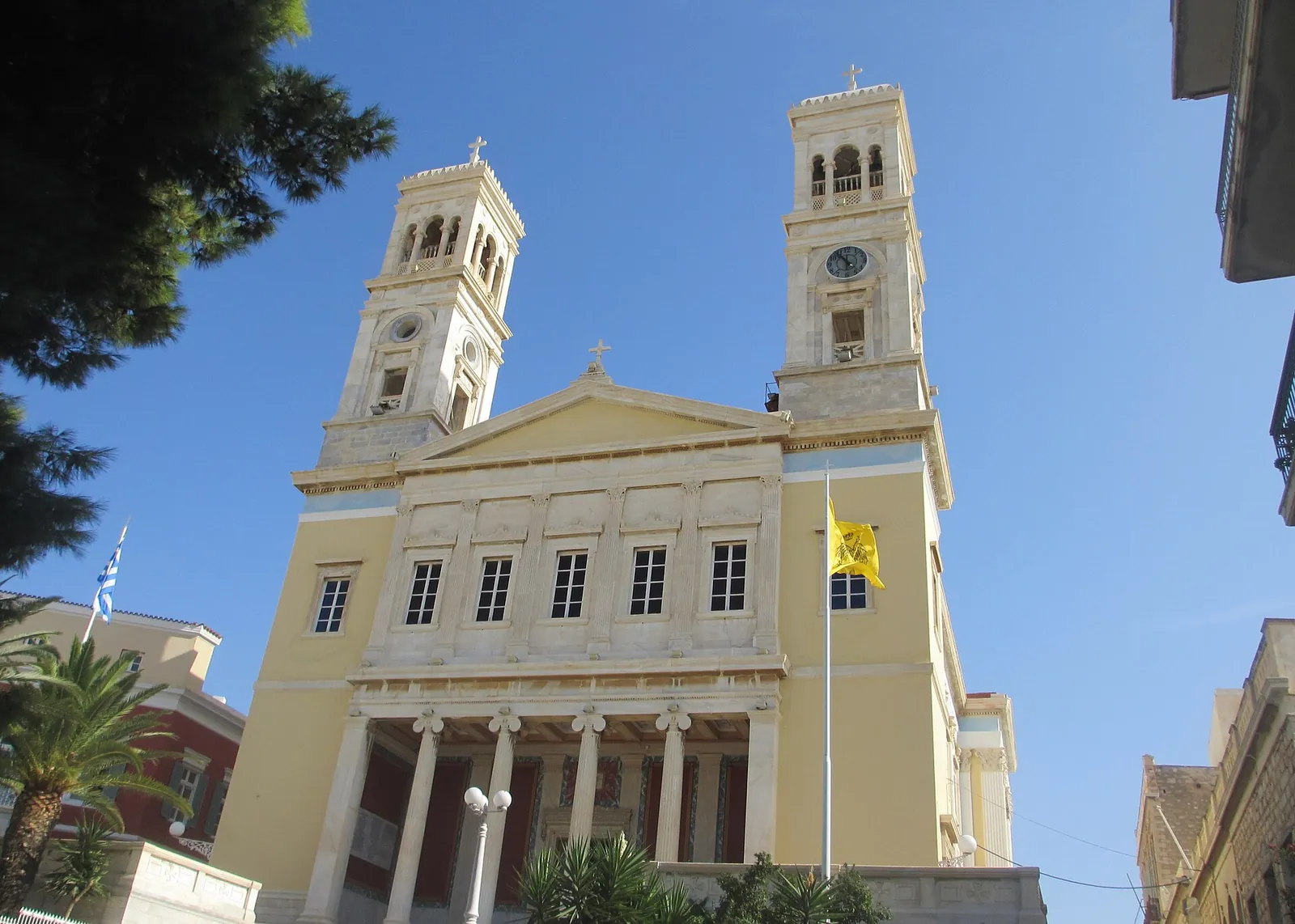
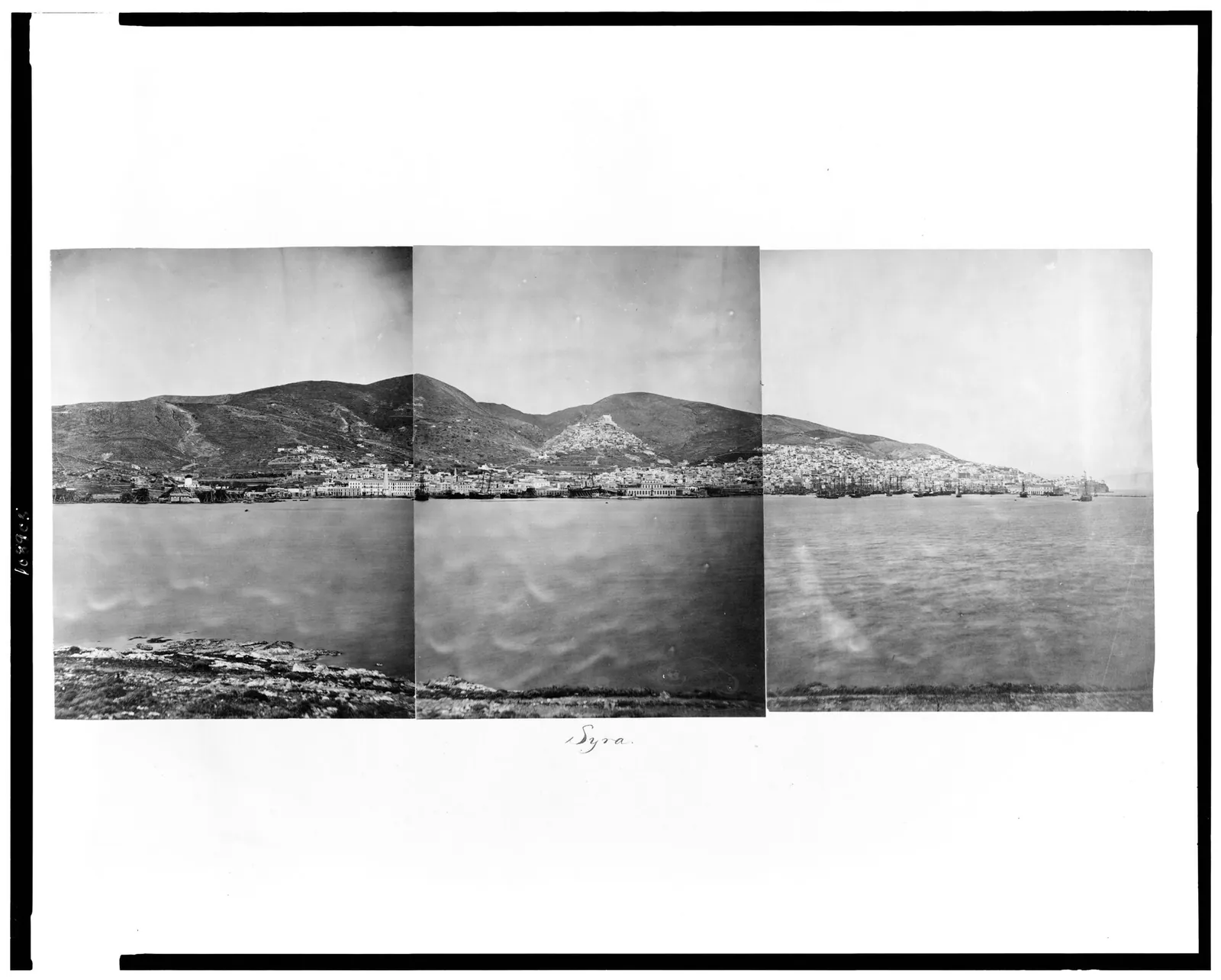
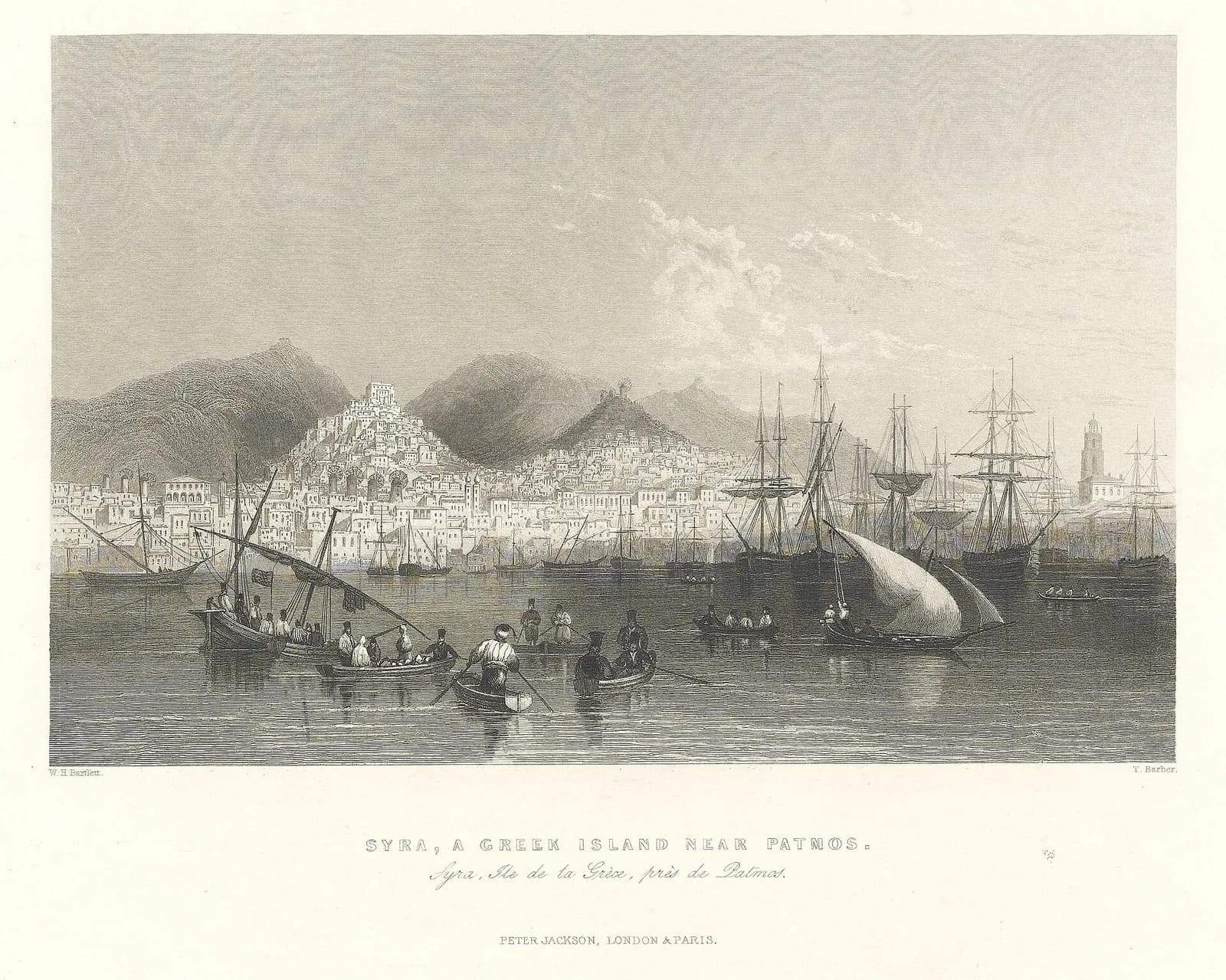
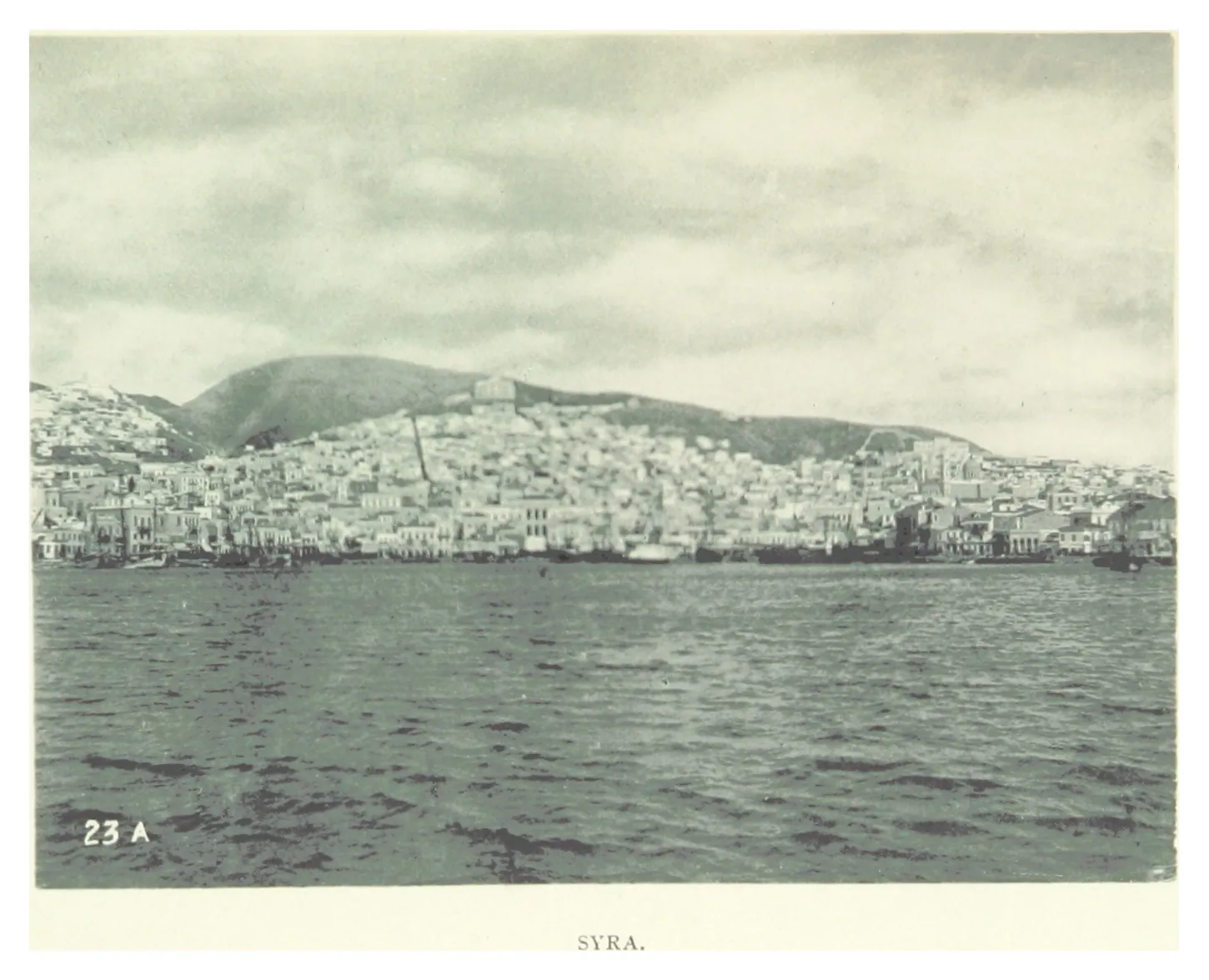
Photo credits
Photographs from Wikimedia Commons, resized, under the licences listed.
- Hermoupolis from the harbour — Zacharias Mitzelos, CC0
- The historic Neorion shipyard, operating since 1861 — Leeturtle, CC BY-SA 3.0
- Ano Syros, the medieval town above Hermoupolis — Sgroey, CC BY-SA 4.0
- Miaoulis Square and the admiral’s statue — Zacharias Mitzelos, CC0
- Hermoupolis Town Hall by Ernst Ziller — Glorious 93, CC BY-SA 4.0
- The Municipal Theatre “Apollo”, 1864 — Zacharias Mitzelos, CC0
- Vaporia, the aristocratic quarter of Hermoupolis — Belisa, Public domain
- Hermoupolis at dusk — Zde, CC BY-SA 4.0
- The ceiling of the Apollo Theatre — Zacharias Mitzelos, CC0
- The staircase of the Apollo Theatre — Zacharias Mitzelos, CC0
- St Nicholas, patron saint of Hermoupolis — Cpandmg, CC BY-SA 4.0
- Syros in the nineteenth century (albumen print) — Library of Congress, Public domain
- The harbour of Syros, nineteenth-century engraving — Wellcome Collection, CC BY 4.0
- Hermoupolis in 1897 — Lambart (1897), Public domain